The bank holding the Single Account matters: forex spreads, transaction fees, branch coverage, and digital-banking integration all vary. Lesson 6.2 walks through the change workflow and the operational discipline needed during transition.

TaRMS Essentials Lesson 6.2
Changing the Single Account Bank
When a taxpayer wants to switch their nominated bank for the Single Account — the workflow, the lag before the new bank takes effect, and the reconciliation discipline during transition.
1
Executive summary
Why a taxpayer might change banks (rate, service, geographic spread); the SSP Change Single Account workflow.
2
Lesson content
The transition lag, in-flight payment reconciliation, and the cleanest payment-pause window.
3
Assessment & policy notes
Common transition pitfalls and a bank-switching playbook.



A. Lesson Context: Bank Choice as a Strategic Decision
B. Legislative Framework
1. Section 34B RAA — Commissioner’s prescribed banks
ZIMRA publishes a list of approved banks; only these may host a Single Account.
2. Practice Note on Bank Changes
ZIMRA Public Notice 4 of 2024 sets the standard transition: the new bank is effective from the first day of the next tax period after approval; in-flight payments to the old bank during the transition window are honoured.
3. Cyber and Data Protection Act
The change of bank involves transfer of taxpayer banking details; the Cyber Act’s data-protection rules apply.
C. Detailed Conceptual Explanation
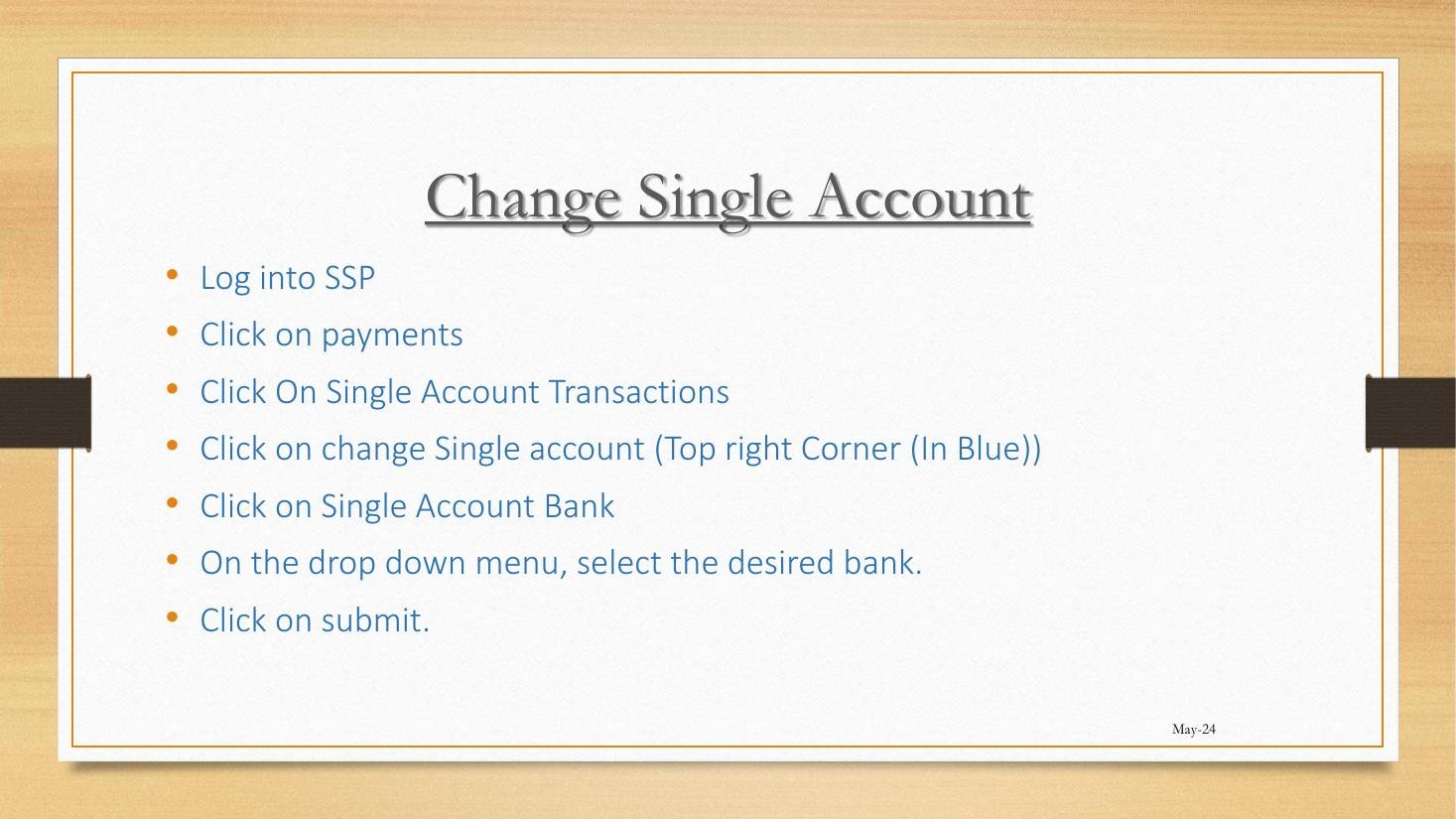
1. Seven-step workflow
- Login to SSP.
- Click Payments.
- Click Single Account Transactions.
- Click Change Single Account (top right, blue).
- Click Single Account Bank.
- From the drop-down, select the desired bank.
- Click Submit.
2. Approval and the lag
ZIMRA validates the new bank choice; processing 5–10 working days. New bank effective from the first day of the next tax period after approval.
3. The transition window discipline
- Pause non-urgent payments during the transition window.
- Continue paying urgent obligations to the old bank until effectivity.
- On effectivity, redirect all bank instructions to the new bank.
- Reconcile both banks for the next 30 days.
4. The bank-list considerations
| Factor | Question to ask |
|---|---|
| Forex spreads | What does the bank charge on USD-ZWG conversion? |
| Transaction fees | Per-transfer fee structure, especially for high-volume payers. |
| Branch network | Geographic spread for cash-deposit needs. |
| Digital-banking integration | Does the bank’s API integrate with the taxpayer’s ERP? |
| Service level | Speed of clearing for ZIMRA-bound transfers. |
D. Real-World Applicability
1. The corporate switching for forex
Cairns Foods’ finance team analyses forex spreads across the approved-bank list and chooses the best. They lodge change request; effective from start of next quarter.
2. The SME with a service complaint
Lily’s current bank’s clearing is slow; she switches. Process is identical regardless of size.
3. The agent-managed transition
An agent advising a client through a switch coordinates the transition window with the client’s cash-flow team to avoid mid-period confusion.
E. Case Law Integration
1. Re Mutare Manufacturing (Special Court 2024)
A taxpayer’s payment was sent to the old bank during transition; ZIMRA initially treated it as unallocated. The court held that the Practice Note on Bank Changes contemplates the transition window and that in-flight payments to the old bank are honoured. Allocation accepted.
F. Common Pitfalls
1. Switching mid-period
Reconciliation pain. Fix: time switches to start of next tax period.
2. Not informing internal payment teams
Payments continue to old bank. Fix: internal communication on effectivity.
3. Choosing on price alone
Service matters. Fix: evaluate on full criteria.
4. Forgetting the new RefNum / Account details
Bank instruction templates need updating. Fix: on effectivity, update all banking templates.
G. Knowledge Check
Question 1
Walk through the seven-step Change Single Account Bank workflow.
Question 2
What is the typical lag between submission and effectivity?
Question 3 — Scenario
You lodge change request 12 March; ZIMRA approves 19 March. When does the new bank become effective for a Category C VAT-registered taxpayer?
Question 4
What does Re Mutare Manufacturing (2024) say about in-flight payments during transition?
H. Quiz Answers with Explanations
Answer 1
Login → Payments → Single Account Transactions → Change Single Account → Single Account Bank → choose bank → Submit.
Answer 2
5–10 working days for ZIMRA processing; effective from first day of next tax period after approval.
Answer 3
For a Category C (monthly) VAT taxpayer, the next tax period starts 1 April. The new bank is effective from 1 April. Pre-1 April payments go to the old bank; post-1 April payments to the new.
Answer 4
The Practice Note on Bank Changes contemplates the transition window. In-flight payments to the old bank during the transition are honoured. Re Mutare Manufacturing (Special Court 2024) confirms allocation acceptance for old-bank in-flight payments.
I. Key Takeaways
- Workflow: Payments → Single Account Transactions → Change Single Account.
- 5–10 working day approval; effective from start of next tax period.
- Transition window: in-flight payments to old bank are honoured.
- Choose bank on full criteria, not price alone.
- Continuity: Lesson 6.3 next teaches transaction search and export.