



• info@taxtami.com
  • +263 772 226 466
  • | |
  • Our Social
  • Home
  • Domestic Tax Courses
    • Income Tax Courses
    • Value Added Tax Courses (VAT)
    • Capital Gains Tax (CGT)
    • ZIMRA Debt Management Courses
  • TaRMS Essentials
    • Course Menu
    • TaRMS Getting Started
    • TaRMS Taxpayer Profile
    • TaRMS Tax Agents & Assignees
    • TaRMS Tax Return Management
    • TaRMS Tax Clearance
    • TaRMS Payments & Single Account
    • TaRMS Taxpayer Accounting
    • TaRMS Capstone Workflows
  • Reve-News
    • Public Notice Updates
    • Detailed Tax Analysis
  • About Us
  • Contact
TaRMS Essentials Lesson 2.2 Adding a New Tax Type: VAT Application The end-to-end VAT registration workflow on the SSP — threshold, voluntary registration, Categories A/B/C/D, the New Tax Type screen, attachments, and the typical 5–10 working day approval cycle.
1

Executive summary

When a taxpayer must register for VAT (compulsory threshold) versus when registration is optional, and the consequences of each.

2

Lesson content

The New Tax Type workflow click-by-click, with annotated screenshots and a real-world Category-selection guide.

3

Assessment & policy notes

Common application pitfalls, knowledge-check questions, and what to do during the post-submission waiting window.

Executive summary
Lesson content
Assessment
A. Context B. Legislative C. Detailed D. Real-World E. Case Law F. Pitfalls G. Knowledge Check H. Quiz Answers I. Takeaways

A. Lesson Context: Why VAT Registration is the Crossroads

For most growing Zimbabwean businesses, VAT registration is the single largest administrative threshold they will cross. Below the threshold, the business is a simple income-tax filer; above it, the business assumes a continuous monthly or bi-monthly compliance obligation, must charge output VAT on every supply, must claim input VAT on every purchase, must reconcile and remit, and must keep an audit-grade trail of tax invoices.

The decision to register — whether forced by the threshold or chosen voluntarily — should never be made in haste. This lesson walks through the legal triggers, the SSP workflow, and the mistakes that turn a straightforward registration into a six-week back-and-forth with ZIMRA.
B. Legislative Framework

1. Compulsory registration: section 23(2) VAT Act

A person who carries on a trade is required to register if their taxable supplies have exceeded, or are reasonably expected to exceed, the prescribed threshold over a 12-month period. The threshold has changed several times; the current figure (set by the Finance Act in force) at the time of writing is USD 25,000 per 12-month period.

2. Voluntary registration: section 23(2)(b)

A person below the threshold may apply voluntarily. Why would they? Because their customers are themselves VAT-registered and want to claim input VAT on the supplier’s invoices.

3. The four Categories — section 27 VAT Act

CategoryFiling periodTypical taxpayer
ABi-monthly (alternate odd-numbered months)SMEs — default category
BBi-monthly (alternate even-numbered months)SMEs assigned by ZIMRA to balance load
CMonthlyLarge operators, those above category turnover threshold
DAnnual or seasonalFarmers, seasonal traders

4. ITF 263 / Tax Clearance interaction

Section 80B ITA requires that a person who has any compulsory registration outstanding cannot obtain a Tax Clearance. A trader operating above the VAT threshold without registering is, by extension, debarred from a clean Tax Clearance.

5. Finance Bill 2026 amendments

The 2026 Bill proposes a tightening of the prescribed-threshold mechanism and gives the Commissioner power to back-date registration to the period in which the threshold was first crossed.

C. Detailed Conceptual Explanation

1. The VAT registration triggers

Two routes to registration: (i) the “look-back” trigger — cumulative taxable supplies in any 12-month period exceed USD 25,000; (ii) the “look-forward” trigger — reasonable expectation that supplies in the next 12 months will exceed the threshold (typical of a new business with a signed major contract).

2. The New Tax Type workflow — click by click

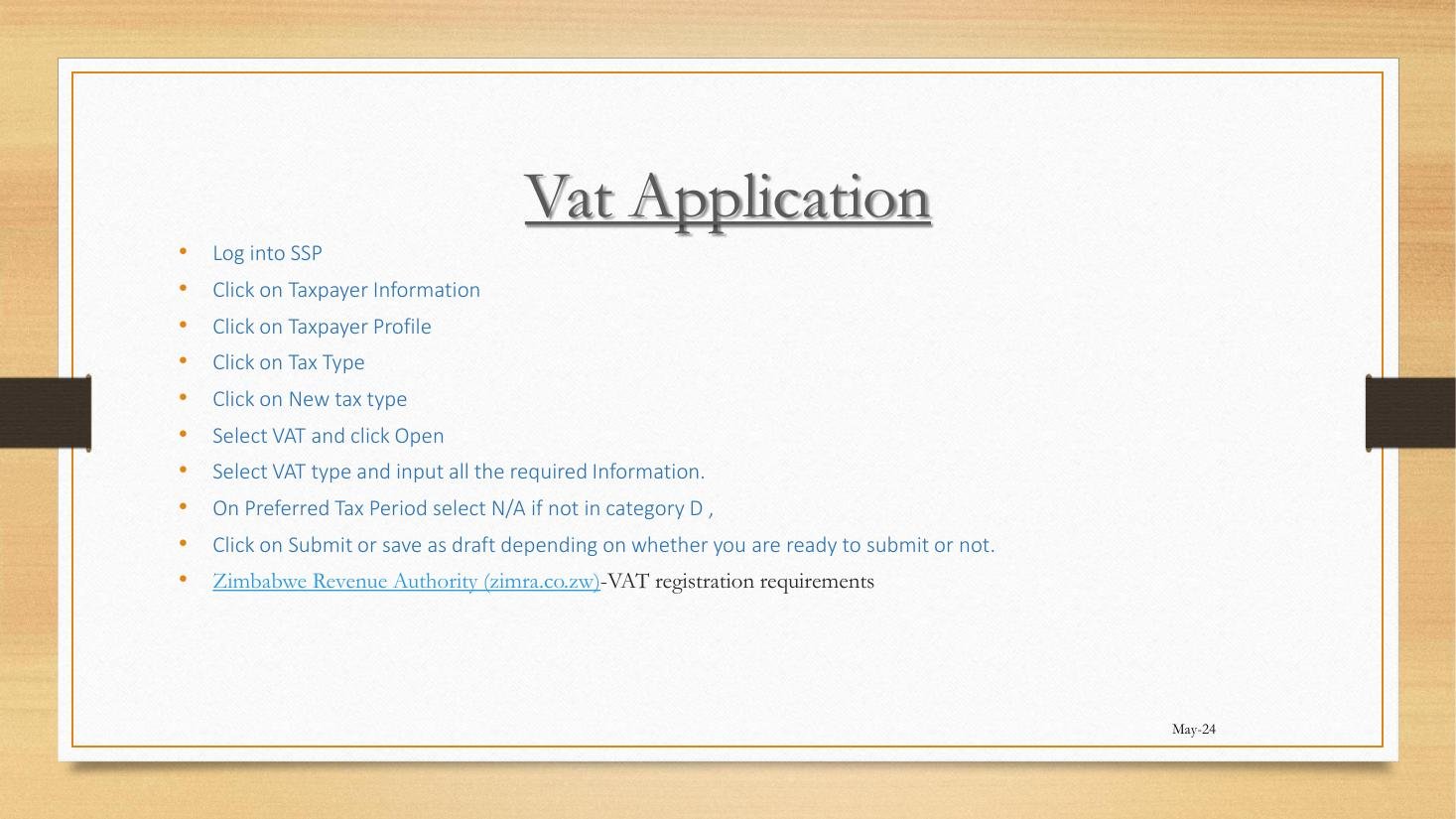
VAT Application steps screen
Figure 2.2.A — The VAT Application screen path summary, drawn from the May 2024 ZIMRA workshop deck.
  1. Login to SSP → Taxpayer Information → Taxpayer Profile.
  2. Select the Tax Type tab.
  3. Click New Tax Type at the top right.
  4. Select VAT from the list and click Open.
  5. Select the VAT type (typically VAT on Goods and Services). Note that VAT on Imported Services is a separate registration.
  6. Complete required fields: trading name, principal place of business, expected turnover, accounting method (invoice / payments).
  7. Preferred Tax Period: select N/A unless the application is for Category D (farmers / seasonal). ZIMRA assigns the default Category A or B.
  8. Attach supporting documents (bank statements showing turnover, signed customer contracts, proof of business address).
  9. Click Submit — or Save as Draft if the documentation is incomplete.

3. Supporting documentation

  • Latest 6 months of bank statements showing trading deposits.
  • Three signed major customer contracts (where look-forward registration is being relied on).
  • Lease or title deed for the principal place of business.
  • CR14 and CR6 for companies; ID for sole traders.
  • Brief written statement explaining the trade and how the threshold was crossed.

4. Approval, rejection, and the post-submission window

ZIMRA aims to process within 5–10 working days. During the window the application is visible under Taxpayer Information → Requests. On approval, the VAT Type appears on the Tax Type tab as Active and the VAT Certificate becomes downloadable (Lesson 1.3). On rejection, ZIMRA issues a notification with reasons; the practitioner remediates and re-applies.

5. The first VAT return after approval

The first VAT return covers the period from the effective date of registration to the end of the relevant tax period. The taxpayer must already have a fiscal device (a Fiscalised Electronic Register) per the FRT 1 form workflow before issuing tax invoices, but in the SSP itself the first return is filed via Tax Return Management (Module 4).

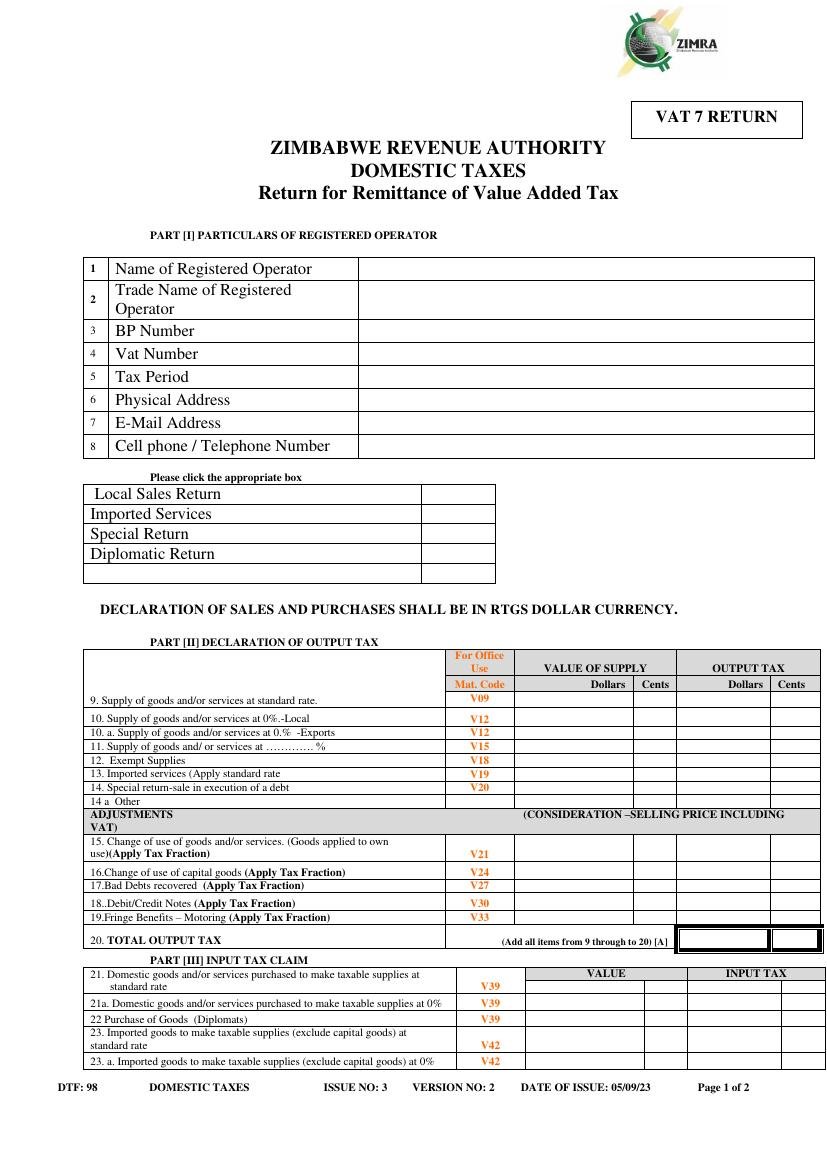
VAT 7 Return form, page 1
Figure 2.2.B — The VAT 7 Return (page 1). This is the data structure TaRMS recreates in the digital VAT return; familiarity with the boxes helps the learner reconcile their books to the return on filing day.

6. Voluntary deregistration vs. compulsory continuation

Once registered, a taxpayer may not deregister at will. Deregistration requires that supplies have fallen and are reasonably expected to remain below the threshold (Lesson 2.3 covers this).

7. Imported Services VAT — a different registration

VAT on Imported Services (section 6(1)(c) of the VAT Act) is a separate registration triggered when the taxpayer receives services from a non-resident supplier for use in making non-taxable supplies. It is technically narrower than VAT on Goods and Services and most SMEs do not register for it.

D. Real-World Applicability

1. Lily crosses the threshold

Recall Lily from Lesson 1.1 — her kiosk grew through 2025 and her trailing-12-month sales hit USD 25,500 in March 2026. She must register for VAT. The decision tree:

  • Confirm the 12-month figure from bank statements.
  • Decide whether to apply the day she crossed (cleanest) or the start of the next month (administratively neater).
  • Choose VAT type: VAT on Goods (standard).
  • Submit on the SSP.
  • While awaiting approval, install a fiscal device (FRT 1 process).
  • On approval, retrofit her invoicing to VAT-inclusive.

2. The voluntary registrant: a B2B services firm

An IT consulting firm with revenue of USD 18,000/year is below the threshold. Its clients are large VAT-registered corporates that want to recover input VAT on the firm’s invoices. The firm registers voluntarily; its prices stay the same gross, but it becomes more attractive to corporate buyers.

3. Categories in practice

PersonaLikely CategoryWhy
Mbare kiosk (Lily)A or BDefault ZIMRA assignment for SMEs
Cairns FoodsCLarge turnover, monthly cycle preferred for cash flow
Mashonaland tobacco farmerDSeasonal income concentrated at auction sales
IT consultancy (voluntary)A or BDefault; can request C if cashflow benefits

4. The waiting-window discipline

During the 5–10 working day window, the practitioner’s checklist:

  • Order a fiscal device per FRT 1 if not already in place.
  • Update accounting software with VAT codes for output and input.
  • Train staff on tax-invoice requirements (section 20 VAT Act).
  • Do not charge output VAT until the registration is approved.
  • Do not issue tax invoices until the VAT number is live.

E. Case Law Integration

1. Commissioner-General, ZIMRA v. Mukoma Industries (Pvt) Ltd (Special Court 2019)

An importer-exporter operated above the threshold for 14 months without registering. ZIMRA back-dated the registration to the month of crossing and assessed output VAT on every supply made over the 14-month period, irrespective of whether the supplier had collected VAT from its customers. The Special Court upheld the assessment: registration is mandatory once the threshold is crossed; non-registration does not exempt from output VAT, it merely means the supplier becomes the bearer of unrecoverable VAT.

Lesson: register early. The cost of late registration is the loss of the ability to pass output VAT to customers retrospectively.

2. Bulawayo Suppliers v. Commissioner-General (Special Court 2021) — voluntary registration not refundable

A trader registered voluntarily, then later argued the registration was a mistake and sought refund of VAT paid. The Special Court held that voluntary registration is binding once approved; the trader must continue to comply until formal deregistration is approved.

3. The South African analogue: ITC 1872 (SARS Tax Court)

Persuasive on the look-forward trigger: a reasonable expectation must be supportable by contemporaneous evidence (signed contracts, financial models). A retrospective assertion of expectation does not satisfy the test.

F. Common Pitfalls

1. Registering too late

The single most expensive VAT mistake. Mukoma Industries (2019) is on point. Fix: monitor trailing-12-month turnover monthly.

2. Charging output VAT before approval

Premature output-VAT collection is a section 80 ITA offence (false statement) and triggers refund of the wrongly-collected amounts to customers. Fix: wait for approval; no exceptions.

3. Wrong Category

Sole traders default to Category A or B; selecting D when not a seasonal trader leads to ZIMRA reassignment and missed deadlines. Fix: select N/A on Preferred Tax Period unless genuinely seasonal.

4. Insufficient documentation

Applications without bank statements or contracts are routinely rejected. Fix: assemble the document pack before clicking Submit.

5. Not installing a fiscal device

VAT registration requires a Fiscalised Electronic Register (FRT 1). Fix: order during the waiting window.

6. Conflating VAT on Goods with VAT on Imported Services

These are separate registrations. Fix: identify the right type in step 5 of the workflow.

7. Assuming registration removes the obligation to file legacy returns

Pre-registration tax obligations remain. Fix: file all outstanding returns before applying.

G. Knowledge Check

Question 1

State the compulsory VAT registration threshold under the Finance Act 2025 and the section of the VAT Act that imposes the duty to register.

Question 2 — Scenario

An SME’s 12-month rolling sales reach USD 26,000 in May 2026. The owner asks if she has any room to defer registration to align with her financial year-end in September. Advise.

Question 3 — Scenario

A B2B services firm with USD 18,000/year turnover is considering voluntary VAT registration. Set out the case for and the case against, and indicate the SSP workflow.

Question 4

Differentiate the four VAT Categories. Which is the default for an SME, and how is Category D triggered?

Question 5

List, in order, the five things a practitioner does during the 5–10 working day post-submission window.

H. Quiz Answers with Explanations

Answer 1

The threshold at the time of writing is USD 25,000 over any 12-month period. The duty to register is imposed by section 23(2) of the VAT Act [Chapter 23:12], with the threshold figure prescribed under the Finance Act in force.

Answer 2

No, she cannot defer. Section 23(2) is a duty, not a discretion. The moment the trailing 12-month sales exceed USD 25,000, the registration obligation crystallises. Practical advice:

  • Lodge the New Tax Type application immediately.
  • The effective date of registration will be the start of the month in which the threshold was crossed (May 2026), or possibly back-dated by ZIMRA per Mukoma Industries (2019).
  • Aligning to the September financial year-end is achievable for accounting purposes (the first VAT return will simply not coincide with year-end), but it has no bearing on the tax-law obligation to register.
  • Failing to register from May exposes her to back-assessed output VAT she cannot pass to customers, plus penalty and interest.

Answer 3

For: Customers are large VAT-registered corporates who can recover input VAT; the firm becomes more competitive in pricing. The firm can also recover input VAT on its own purchases (laptops, software subscriptions). Against: Continuous monthly or bi-monthly compliance burden (5–15 hours/month if outsourced); pricing must reset to VAT-inclusive; fiscal device must be installed; record-keeping intensifies.

Workflow: Same as compulsory registration. Login to SSP → Taxpayer Profile → Tax Type → New Tax Type → VAT → Open. The application form has a tick-box indicating voluntary registration.

Answer 4

Category A — bi-monthly, odd months. Category B — bi-monthly, even months. Category C — monthly. Category D — annual or seasonal. Default for an SME is A or B (assigned by ZIMRA for load balancing). Category D is granted only on application for genuinely seasonal traders (farmers, tobacco-auction operators).

Answer 5

  1. Order a Fiscalised Electronic Register (FRT 1).
  2. Update accounting software with VAT codes.
  3. Train staff on tax-invoice requirements (section 20 VAT Act).
  4. Do not charge output VAT.
  5. Monitor the SSP Requests inbox for the approval notification.

I. Key Takeaways

  • Section 23(2) VAT Act — the compulsory registration trigger.
  • USD 25,000 over 12 months is the current threshold; monitored monthly.
  • Four Categories: A/B bi-monthly, C monthly, D annual/seasonal.
  • Workflow: Taxpayer Profile → Tax Type → New Tax Type → VAT → Open.
  • Pre-approval: do not charge output VAT, do not issue tax invoices.
  • Mukoma Industries (2019): late registration costs the supplier unrecoverable VAT.
  • Voluntary registration is binding (Bulawayo Suppliers 2021).
  • Continuity: Lesson 2.3 next covers the reverse path — deregistering a tax type.
TaRMS Essentials Lesson 1.1
Introduction to TaRMS
TaRMS Essentials Lesson 1.2
Logging In & Navigation
TaRMS Essentials Lesson 1.3
TIN & VAT Certificates
TaRMS Essentials Lesson 2.1
Taxpayer Profile
TaRMS Essentials Lesson 2.2
VAT Application
TaRMS Essentials Lesson 2.3
Tax Type Deregistration
TaRMS Essentials Lesson 2.4
TIN Deregistration
TaRMS Essentials Lesson 3.1
Tax Agent Registration
TaRMS Essentials Lesson 3.2
Tax Agent Licence
TaRMS Essentials Lesson 3.3
Assigning Tax Agents
TaRMS Essentials Lesson 3.4
Roles & Assignees
TaRMS Essentials Lesson 4.1
Return Submission
TaRMS Essentials Lesson 4.2
PAYE Return Submission
TaRMS Essentials Lesson 4.3
Amending Current Returns
TaRMS Essentials Lesson 4.4
Filing Past Returns
TaRMS Essentials Lesson 5.1
Automatic Tax Clearance
TaRMS Essentials Lesson 5.2
Manual Tax Clearance
TaRMS Essentials Lesson 6.1
The Single Account
TaRMS Essentials Lesson 6.2
Changing Single Account Bank
TaRMS Essentials Lesson 6.3
Single Account Transactions
TaRMS Essentials Lesson 7.1
Summary Report
TaRMS Essentials Lesson 7.2
Tax Type Report
TaRMS Essentials Lesson 7.3
Assessment Notices
TaRMS Essentials Lesson 8.1
VAT Compliance Workflow
TaRMS Essentials Lesson 8.2
PAYE Compliance Workflow
TaRMS Essentials Lesson 8.3
Common Pitfalls
TaRMS Essentials Lesson 8.4
Monthly & Quarterly Routine
Full Course Menu
TaRMS Essentials
TaxTami TaxTami

Zimbabwe's leading tax education platform, making Zimbabwean tax law simple for students, professionals and business owners.

Courses

  • Income Tax
  • Value Added Tax
  • Capital Gains Tax
  • Debt Management
  • TaRMS Essentials

Company

  • About
  • Team
  • Blog
  • Contact Us

Resources

  • Help
  • Support
  • Sitemap
  • Community

© TaxTami. All rights reserved.

  • Terms and Conditions
  • Privacy Policy