
• info@taxtami.com
  • +263 772 226 466
  • | |
  • Our Social
  • Home
  • Domestic Tax Courses
    • Income Tax Courses
    • Value Added Tax Courses (VAT)
    • Capital Gains Tax (CGT)
    • ZIMRA Debt Management Courses
  • TaRMS Essentials
    • Course Menu
    • TaRMS Getting Started
    • TaRMS Taxpayer Profile
    • TaRMS Tax Agents & Assignees
    • TaRMS Tax Return Management
    • TaRMS Tax Clearance
    • TaRMS Payments & Single Account
    • TaRMS Taxpayer Accounting
    • TaRMS Capstone Workflows
  • Reve-News
    • Public Notice Updates
    • Detailed Tax Analysis
  • About Us
  • Contact
TaRMS Essentials Lesson 3.1 Tax Agent Registration The licensing pathway for any individual or firm that wants to act on a Zimbabwean taxpayer’s behalf in TaRMS, anchored in SI 125 of 2023 and the SSP’s Register-as-Tax-Agent workflow.
1

Executive summary

Eligibility under SI 125 of 2023, the requirement that the firm and each handler hold a TIN, and the application steps.

2

Lesson content

The Register-as-Tax-Agent workflow click-by-click, the documents ZIMRA expects, and the 9-digit Licence Number issued on approval.

3

Assessment & policy notes

Common application errors, the post-approval onboarding routine, and a quick reference for renewals.

Executive summary
Lesson content
Assessment
A. Context B. Legislative C. Detailed D. Real-World E. Case Law F. Pitfalls G. Knowledge Check H. Quiz Answers I. Takeaways

A. Lesson Context: Why Licensed Tax Agency Matters

Before October 2023, anyone with a passable understanding of tax could call themselves a “tax agent” in Zimbabwe and lodge returns on a client’s behalf using shared credentials. Statutory Instrument 125 of 2023 — the Tax Agent (Licensing) Regulations — ended that. Today, every individual or firm transacting on another person’s TIN must be licensed by ZIMRA, hold a 9-digit Licence Number, and operate inside the controls Module 3 sets up.

This is the gateway lesson for Module 3. Lesson 3.2 will treat licence management; Lesson 3.3 will cover the assignment of an agent to a client TIN; Lesson 3.4 will explain how an agent firm structures internal access via Roles and Assignees. Get Lesson 3.1 right and the rest of the module is execution.

Why this matters commercially: A Tax Agent licence is the asset that allows a firm to scale beyond a sole-trader practice. Without it, every additional client requires the firm to share their own SSP credentials — a practice that is now unlawful and uninsurable.
B. Legislative Framework

1. SI 125 of 2023 — the Tax Agent (Licensing) Regulations

The principal subordinate legislation. Key provisions:

  • Reg. 3 — eligibility: must hold a TIN, must demonstrate fit-and-proper character, must hold relevant qualifications (e.g., ACCA, CIS, Bachelor’s degree in accounting/tax/law for individuals; partnership/company with at least one qualifying member for firms).
  • Reg. 5 — application form and supporting documents.
  • Reg. 7 — licence period: one calendar year, renewable.
  • Reg. 9 — conduct standards and grounds for revocation.
  • Reg. 11 — offence to act as a tax agent without a licence.

2. Section 80 ITA — false statements

An unlicensed person who lodges returns is, by definition, lodging without authority — potentially triggering section 80 of the Income Tax Act for false statements.

3. Cyber and Data Protection Act

Acting on a client’s SSP credentials without a Tax Agent licence is unauthorised access under section 16 of the Cyber and Data Protection Act.

4. Practice Note on Tax Agent Licensing

ZIMRA’s Public Notice 14 of 2023 elaborates the documentation requirements and the standard turnaround for processing.

5. Finance Act 2025 amendments

The Finance Act 2025 codified the obligation more firmly by referencing SI 125 in the body of the Revenue Authority Act, putting the licensing scheme on a primary-legislation footing.

Statutory takeaway: Tax-agency in Zimbabwe is now a regulated profession. Reg. 11 of SI 125 of 2023 makes unlicensed practice an offence; section 16 of the Cyber Act makes credential-sharing an additional offence; section 80 ITA makes any return so lodged a false-statement risk.

C. Detailed Conceptual Explanation

Workshop slide on Tax Agent eligibility under SI 125 of 2023
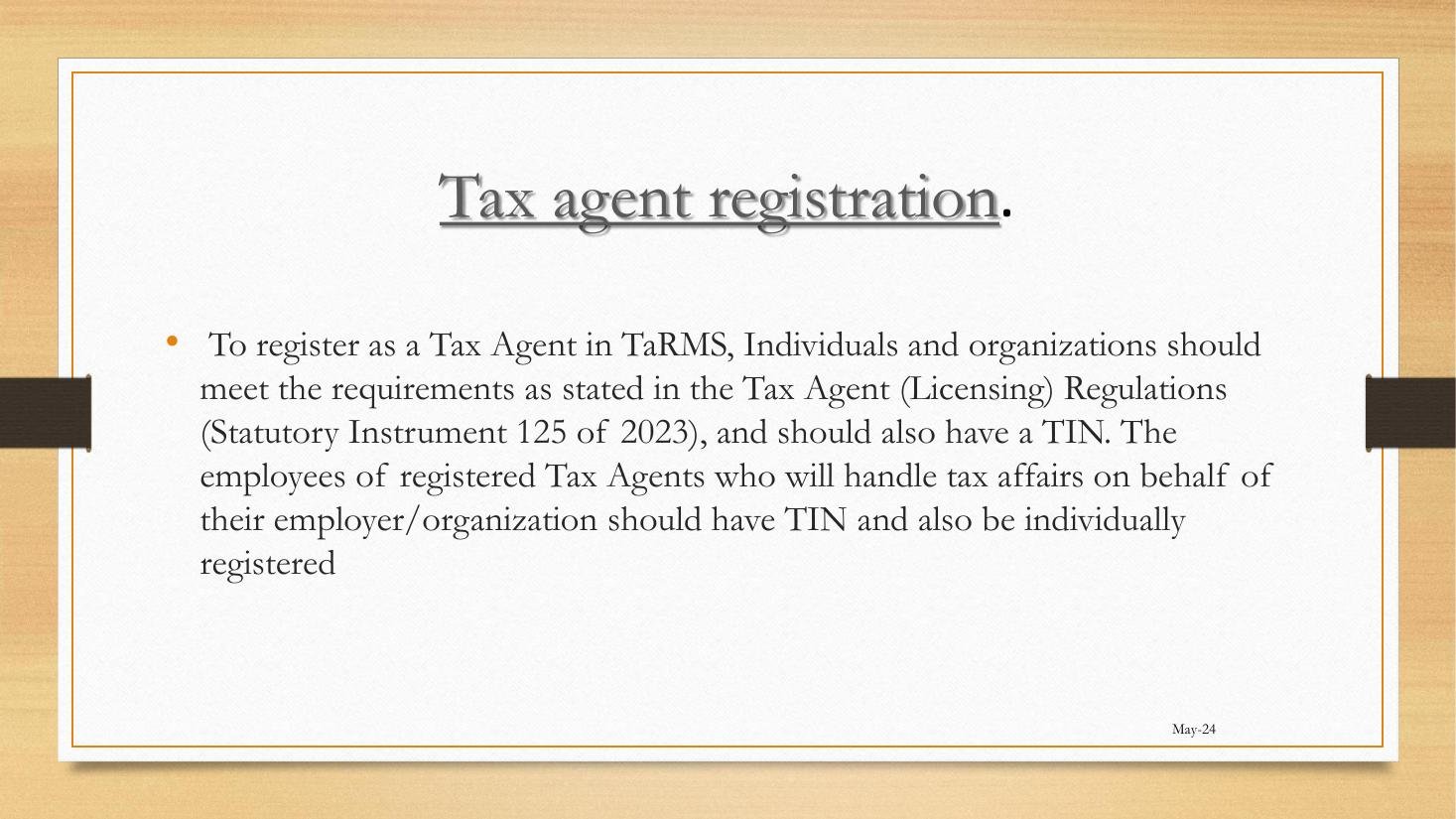
Figure 3.1.A — ZIMRA workshop slide stating the SI 125 of 2023 eligibility requirement: TIN holding for both the firm and each handler, fit-and-proper character, relevant qualifications.

1. Who must register

Anyone who, in return for fee or as part of their employed duties, transacts with ZIMRA on another person’s tax affairs:

  • Sole-practitioner accountants, lawyers, tax consultants.
  • Accounting firms (partnerships and companies).
  • Law firms with a tax-advisory practice.
  • Corporate-services firms preparing returns for clients.

Not required to register: an in-house finance team filing for their own employer; a director filing for their own company through their personal Authorised-Person status (though delegating to a non-director still requires the Assignee structure of Lesson 3.4).

2. Eligibility checklist

  • TIN: held by the applicant individual; held by the firm if the application is corporate.
  • Qualifications: at least one principal must hold a recognised accounting / tax / law qualification.
  • Fit-and-proper: no recent tax convictions or pending disciplinary matters with a professional body.
  • Practising firm structure: registered partnership or company in good standing.
  • Indemnity insurance: emerging best practice; not yet a hard SI requirement, but ZIMRA may verify.

3. The Register-as-Tax-Agent workflow

Tax Agent registration steps from workshop
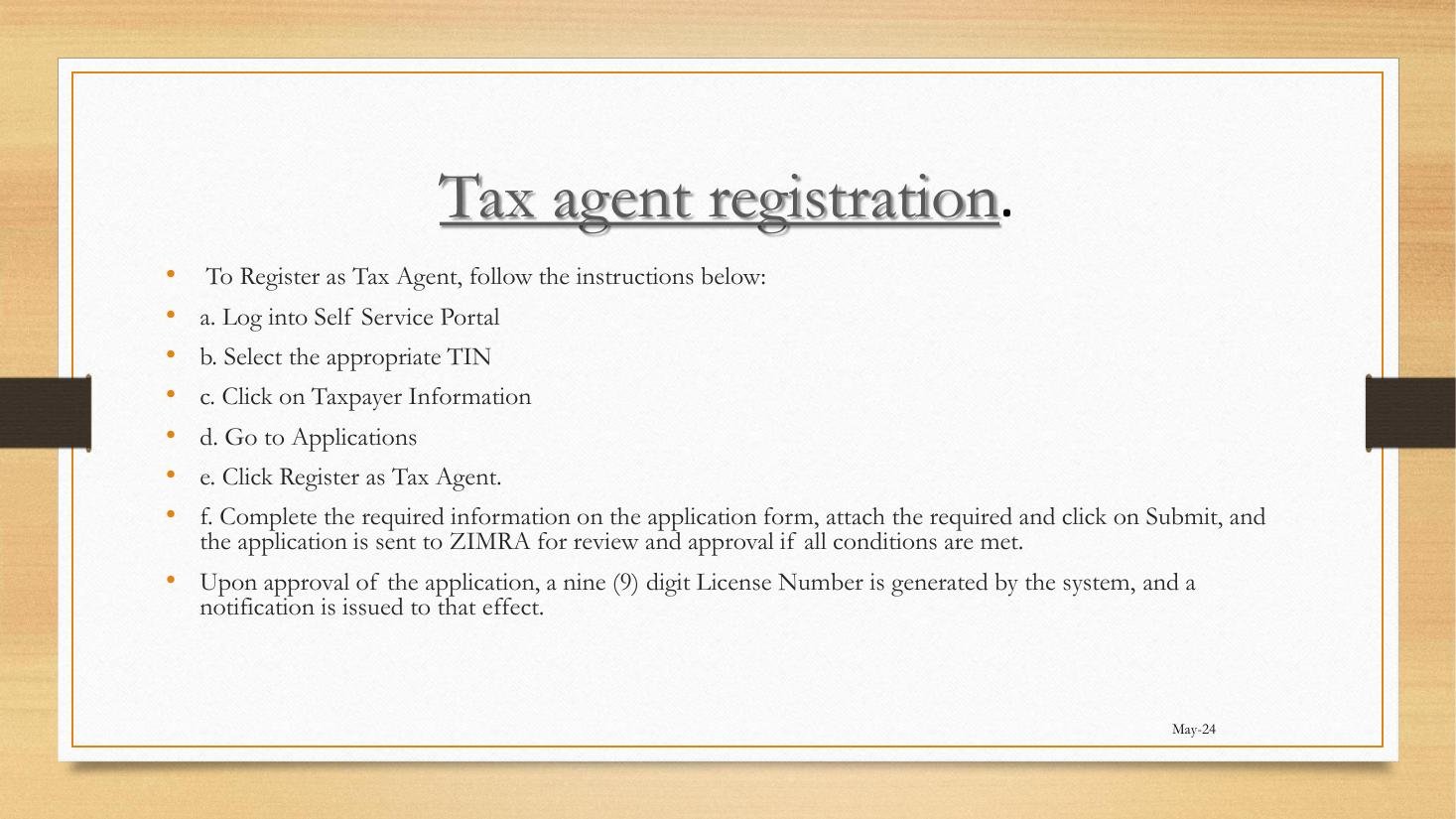
Figure 3.1.B — The eight-step Register-as-Tax-Agent workflow as articulated in the May 2024 webinar.
  1. Login to SSP under the applicant’s personal or firm TIN.
  2. Select the appropriate TIN at the top right.
  3. Click Taxpayer Information.
  4. Click Applications.
  5. Click Register as Tax Agent.
  6. Complete the application: firm name, principal contacts, qualifications, intended scope of practice.
  7. Attach: certified copies of qualifications, CR documents (for companies), partnership deed (for partnerships), CV of principal practitioners, indemnity insurance certificate (if held), recent tax-clearance for the applicant.
  8. Click Submit. The application is routed to ZIMRA for review.

4. Approval, licence number, and certificate

On approval, ZIMRA generates a 9-digit Licence Number and issues a Tax Agent Certificate viewable under Taxpayer Information → Tax Agent Activity. The licence is valid for one year (Reg. 7).

5. The Tax Agent Management module — what becomes available on approval

FunctionalityLesson
Register as Tax Agent3.1 (this lesson)
View / download Tax Agent Certificate3.2
Change Tax Agent status3.2
Apply for licence renewal3.2
Assign Tax Agent (a client assigning the licensed firm)3.3
Remove Tax Agent3.3
Create / delete assignees of Tax Agent3.4
Edit Tax Agent default roles3.4

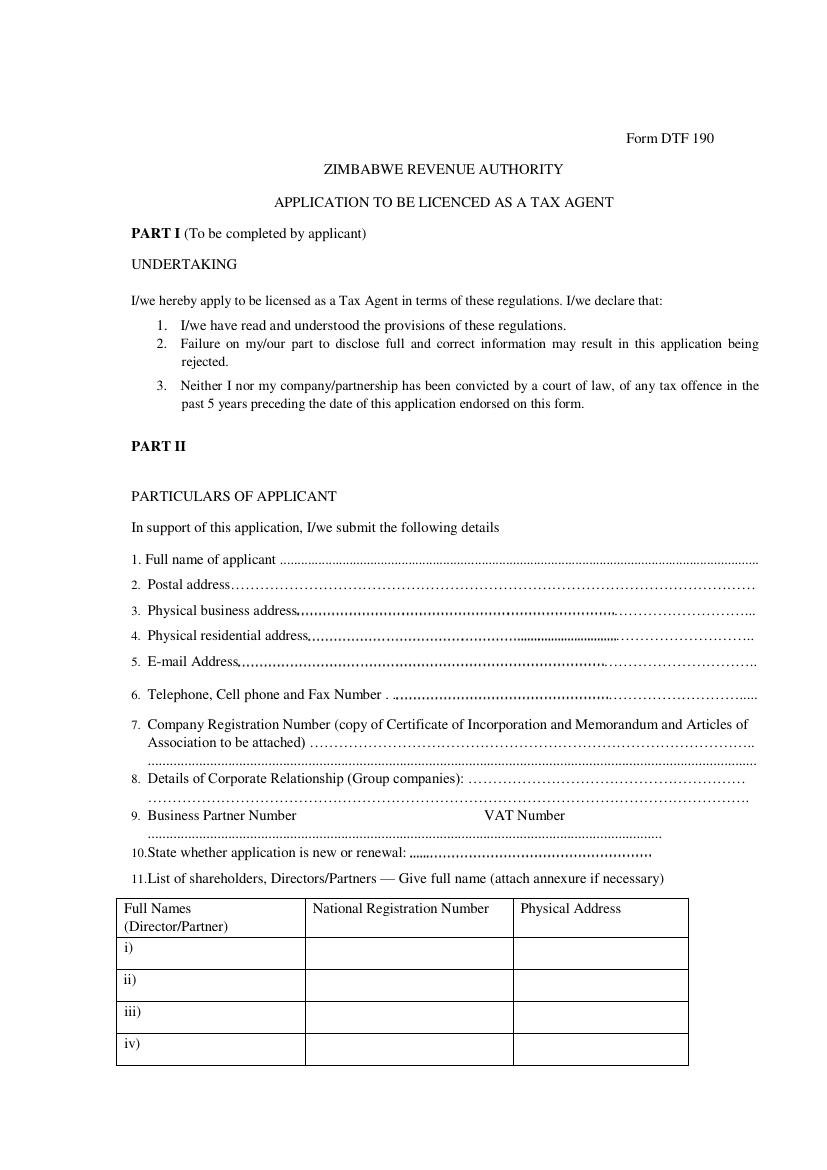
6. The legacy paper Form — what it tells you

Tax Agents Registration Form (paper)
Figure 3.1.C — The legacy Tax Agents Registration Form, page 1. Now superseded by the SSP workflow but useful as a data-capture template — it tells you which fields TaRMS treats as material.

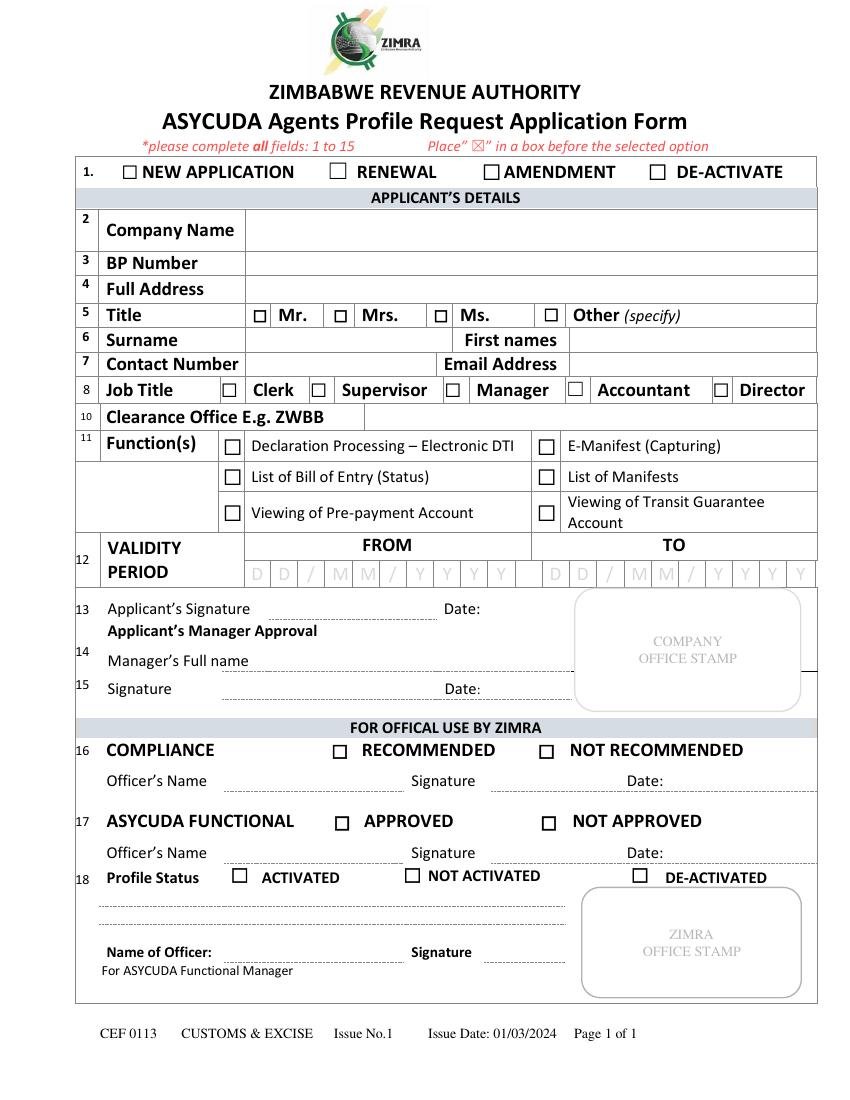
7. The Agents Profile Request Application Form

Agents Profile Request Application Form
Figure 3.1.D — The Agents Profile Request Application Form, page 1 — used in conjunction with the registration workflow when a client wishes to formally appoint an agent on the agent’s SSP profile.

8. Renewal cadence

Licences run for one calendar year. ZIMRA notifies the agent 60 days before expiry. Renewal is a lighter-touch workflow on the same module — no fresh qualifications upload required, but the fit-and-proper attestation must be re-affirmed.

D. Real-World Applicability

1. The sole-practitioner accountant

An ACCA-qualified accountant runs a one-person practice. She registers as a Tax Agent under her own TIN. Her 9-digit licence is the core asset of her practice. Each new client assigns her licence to their TIN under Lesson 3.3, and she switches between client TINs using the top-right selector (Lesson 1.2).

2. The mid-sized accounting firm

A partnership of 4 partners with 12 staff. The firm itself is the licensed Tax Agent. The 4 partners and 12 staff are Assignees within the firm under Lesson 3.4 — each has their own SSP login and their own role permissions on the firm’s licence.

3. The corporate finance team

An in-house corporate tax team does not need a Tax Agent licence to file the company’s own returns. The team uses Assignee structures (Lesson 3.4) within the company’s TIN.

4. The post-approval onboarding routine

  • Download the Tax Agent Certificate; print and display.
  • Update firm letterhead with the 9-digit Licence Number.
  • Set up Roles within the firm (Lesson 3.4).
  • Create Assignees for each member of staff who will transact.
  • Communicate the licence number to clients so they can assign the firm to their TINs.
  • Diary the renewal date 60 days before expiry.

E. Case Law Integration

1. Adventure Communications — reprised

The South African case (Tax Court 2021) treated unauthorised practice on a client’s credentials as binding the agent to the contents of the return. The principle is highly persuasive in Zimbabwe under section 80 ITA.

2. Re Pamberi Tax Consultants (Magistrates’ Court 2024)

A short post-SI 125 case — a self-styled “tax consultant” without a Tax Agent licence was charged under Reg. 11 for filing returns for fee on behalf of three clients. Conviction; fine equal to USD 1,500. The case is the first reported domestic application of SI 125.

3. The data-protection overlay

POTRAZ guidance (2024) treats client data held by an unlicensed practitioner as held without lawful basis under sections 7 and 8 of the Cyber and Data Protection Act, exposing the practitioner to civil liability in addition to the criminal penalty under SI 125.

F. Common Pitfalls

1. Continuing to practise unlicensed during the 2024 transition

The Reg. 11 offence is now active. Fix: register without further delay.

2. Using personal TIN for firm work

Where the firm is a partnership or company, the firm’s TIN must be the licensed TIN. Fix: ensure the firm holds a TIN and that the licence is in the firm’s name.

3. Sharing the firm’s SSP login among staff

Each staff member must have an Assignee login (Lesson 3.4). Fix: set up Assignees on day one of practice.

4. Letting the licence lapse

Practice during a lapsed licence is unlicensed practice. Fix: diary renewals 60 days in advance.

5. Operating outside scope of practice

The Tax Agent licence covers tax matters; it does not authorise legal-advice work or audit-engagement work. Fix: stay within scope; partner with a law firm or audit firm where overlap arises.

6. Forgetting indemnity insurance

While not strictly mandated by SI 125, ZIMRA’s practice notes increasingly check for it on renewal. Fix: obtain a professional indemnity policy.

G. Knowledge Check

Question 1

What is SI 125 of 2023, what does Reg. 11 criminalise, and what was the outcome in Re Pamberi Tax Consultants (2024)?

Question 2

Distinguish the eligibility requirements for an individual applicant from those for a firm applicant.

Question 3 — Scenario

Three accountants form a partnership. Two are ACCA-qualified; one is BCom-qualified but has not joined a professional body. Can the partnership register as a Tax Agent? What about each accountant individually?

Question 4 — Scenario

An in-house tax team of a corporate is filing the company’s own returns. Must the team members hold individual Tax Agent licences?

Question 5

Walk through the 8-step Register-as-Tax-Agent workflow.

H. Quiz Answers with Explanations

Answer 1

SI 125 of 2023 is the Tax Agent (Licensing) Regulations, the subordinate legislation under the Revenue Authority Act that licenses tax agency in Zimbabwe. Reg. 11 makes it an offence to act as a tax agent without a licence. Re Pamberi Tax Consultants (Magistrates’ Court 2024) is the first reported conviction: an unlicensed practitioner who filed for three clients was fined USD 1,500.

Answer 2

Individual applicant: TIN, recognised qualification (ACCA, CIS, accounting/tax/law degree), fit-and-proper character. Firm applicant: TIN held by the firm, registered partnership or company in good standing, at least one qualifying member, fit-and-proper across the principals, partnership deed or CR documents.

Answer 3

The partnership can register as a firm because at least one member (in fact two) is qualified. The two ACCA partners can also register as individuals if they wish to maintain a personal practice alongside the partnership. The BCom-qualified partner is not eligible as an individual applicant under Reg. 3 unless they join a professional body or complete an additional qualifying course; they remain a partner of the licensed firm and can transact under the firm’s licence as an Assignee (Lesson 3.4).

Answer 4

No. Tax Agent licensing is for those who transact on another person’s TIN. An in-house team filing for their employer is filing for their own legal entity (the corporate TIN). They are structured as Assignees within that TIN under Lesson 3.4.

Answer 5

Per Section C3 above: (1) Login. (2) Switch to firm TIN. (3) Taxpayer Information. (4) Applications. (5) Register as Tax Agent. (6) Complete application. (7) Attach documents. (8) Submit.

I. Key Takeaways

  • SI 125 of 2023 is the master licensing regulation; Reg. 11 makes unlicensed practice an offence.
  • Eligibility requires TIN + qualification + fit-and-proper character.
  • 9-digit Licence Number issued on approval; valid for one calendar year.
  • Workflow: Taxpayer Information → Applications → Register as Tax Agent.
  • In-house teams do not need licensing; only those acting on other people’s TINs.
  • Continuity: Lesson 3.2 covers licence management — viewing certificate, status changes, renewals.
TaRMS Essentials Lesson 1.1
Introduction to TaRMS
TaRMS Essentials Lesson 1.2
Logging In & Navigation
TaRMS Essentials Lesson 1.3
TIN & VAT Certificates
TaRMS Essentials Lesson 2.1
Taxpayer Profile
TaRMS Essentials Lesson 2.2
VAT Application
TaRMS Essentials Lesson 2.3
Tax Type Deregistration
TaRMS Essentials Lesson 2.4
TIN Deregistration
TaRMS Essentials Lesson 3.1
Tax Agent Registration
TaRMS Essentials Lesson 3.2
Tax Agent Licence
TaRMS Essentials Lesson 3.3
Assigning Tax Agents
TaRMS Essentials Lesson 3.4
Roles & Assignees
TaRMS Essentials Lesson 4.1
Return Submission
TaRMS Essentials Lesson 4.2
PAYE Return Submission
TaRMS Essentials Lesson 4.3
Amending Current Returns
TaRMS Essentials Lesson 4.4
Filing Past Returns
TaRMS Essentials Lesson 5.1
Automatic Tax Clearance
TaRMS Essentials Lesson 5.2
Manual Tax Clearance
TaRMS Essentials Lesson 6.1
The Single Account
TaRMS Essentials Lesson 6.2
Changing Single Account Bank
TaRMS Essentials Lesson 6.3
Single Account Transactions
TaRMS Essentials Lesson 7.1
Summary Report
TaRMS Essentials Lesson 7.2
Tax Type Report
TaRMS Essentials Lesson 7.3
Assessment Notices
TaRMS Essentials Lesson 8.1
VAT Compliance Workflow
TaRMS Essentials Lesson 8.2
PAYE Compliance Workflow
TaRMS Essentials Lesson 8.3
Common Pitfalls
TaRMS Essentials Lesson 8.4
Monthly & Quarterly Routine
Full Course Menu
TaRMS Essentials
TaxTami TaxTami

Zimbabwe's leading tax education platform, making Zimbabwean tax law simple for students, professionals and business owners.

Courses

  • Income Tax
  • Value Added Tax
  • Capital Gains Tax
  • Debt Management
  • TaRMS Essentials

Company

  • About
  • Team
  • Blog
  • Contact Us

Resources

  • Help
  • Support
  • Sitemap
  • Community

© TaxTami. All rights reserved.

  • Terms and Conditions
  • Privacy Policy