



• info@taxtami.com
  • +263 772 226 466
  • | |
  • Our Social
  • Home
  • Domestic Tax Courses
    • Income Tax Courses
    • Value Added Tax Courses (VAT)
    • Capital Gains Tax (CGT)
    • ZIMRA Debt Management Courses
  • TaRMS Essentials
    • Course Menu
    • TaRMS Getting Started
    • TaRMS Taxpayer Profile
    • TaRMS Tax Agents & Assignees
    • TaRMS Tax Return Management
    • TaRMS Tax Clearance
    • TaRMS Payments & Single Account
    • TaRMS Taxpayer Accounting
    • TaRMS Capstone Workflows
  • Reve-News
    • Public Notice Updates
    • Detailed Tax Analysis
  • About Us
  • Contact
TaRMS Essentials Lesson 2.4 TIN Deregistration The deepest workflow in Module 2 — closing the entire TIN. When it is appropriate (cessation, death, deregistration of company), what survives, and the SSP path on the General Information tab.
1

Executive summary

The legal predicates for TIN closure (cessation of trade, death, dissolution of company), and the surviving obligations.

2

Lesson content

The Status Change to Deregister workflow, the documentation pack, and ZIMRA’s validation procedures.

3

Assessment & policy notes

Common errors and a coordinated wind-down checklist for an entity exiting the tax system.

Executive summary
Lesson content
Assessment
A. Context B. Legislative C. Detailed D. Real-World E. Case Law F. Pitfalls G. Knowledge Check H. Quiz Answers I. Takeaways

A. Lesson Context: When the Whole TIN Goes

Module 2 began with adding tax types and ends with closing the whole record. TIN deregistration is the most consequential single action a taxpayer ever performs in TaRMS — it terminates the relationship with ZIMRA at the master-record level. It is rare, but when it happens, it must happen correctly.

Three predicates make TIN deregistration appropriate: cessation of trade with no expectation of resumption; death of an individual taxpayer (handled by the executor); and final dissolution of a company at the registrar of companies.
B. Legislative Framework

1. Section 80B Income Tax Act — the “tax obligations are settled” precondition

By analogy to the tax-clearance regime, TIN deregistration is approved only where every tax-head obligation has been settled and every return filed. ZIMRA does not deregister an indebted taxpayer.

2. Section 51 ITA — record retention beyond deregistration

Deregistration does not extinguish the six-year record-retention obligation. The records must continue to be available, archived, in case ZIMRA opens a retrospective audit.

3. Companies Act and the dissolution overlay

For a company, TIN deregistration must follow, not precede, dissolution at the registrar of companies. ZIMRA cross-references CR documents.

4. Estate handling: section 52 ITA

On death of an individual, the executor files final returns up to the date of death. The estate may continue to need the TIN for post-death capital gains and final winding-up. TIN deregistration occurs only on completion of estate administration.

5. Practice Note on TIN Deregistration

ZIMRA Public Notice 09 of 2024 sets out the standard documentation pack: cessation-of-trade resolution, evidence of dissolution / death, final returns, settlement of Single Account.

C. Detailed Conceptual Explanation

TIN Deregistration steps
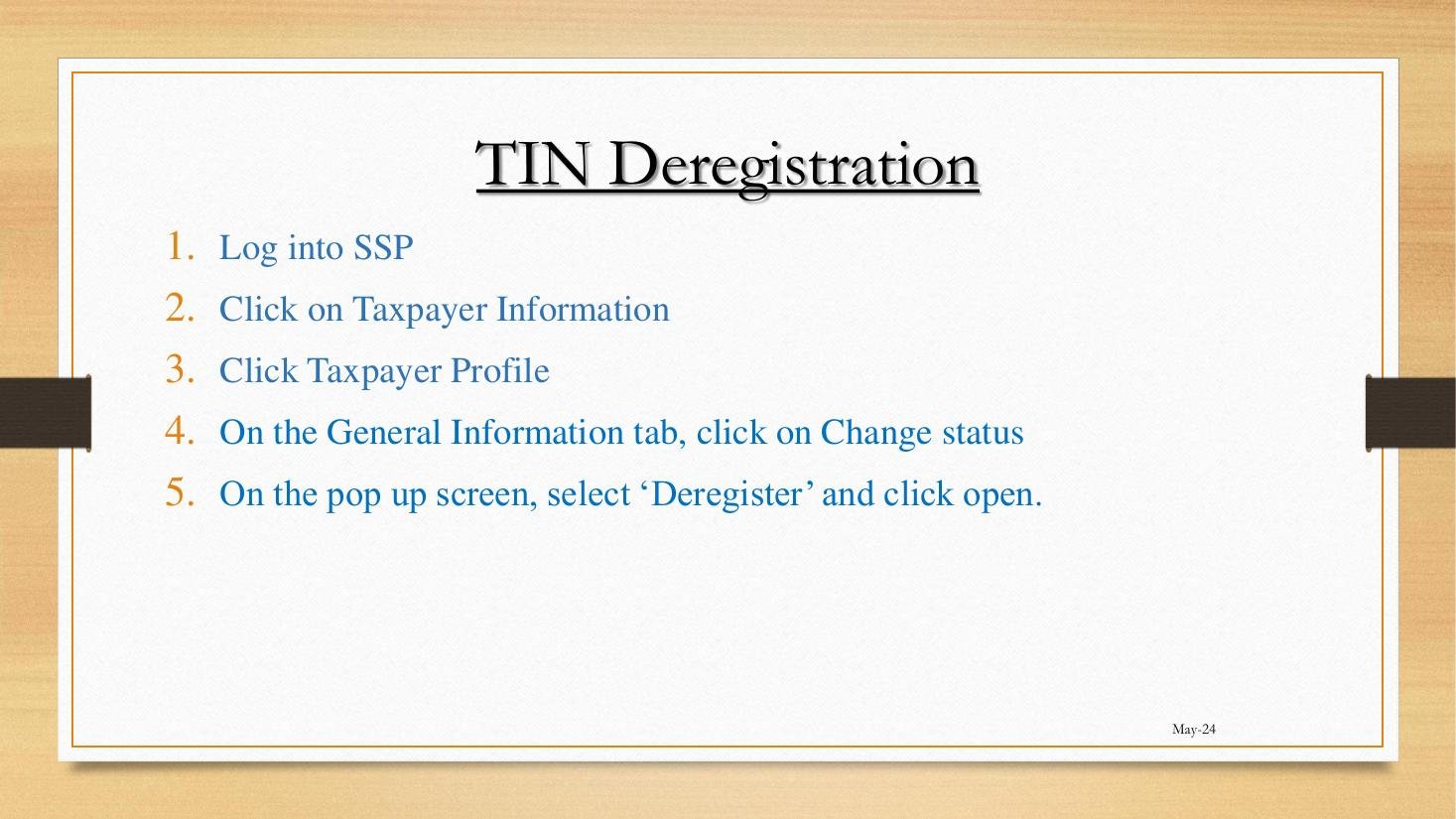
Figure 2.4.A — The TIN Deregistration path on the Taxpayer Profile General Information tab.

1. Workflow click by click

  1. Login to SSP.
  2. Click Taxpayer Information.
  3. Click Taxpayer Profile.
  4. On the General Information tab, click Change Status.
  5. From the pop-up, select Deregister and click Open.
  6. Provide the reason for deregistration; attach the documentation pack.
  7. Submit. Profile status moves to Pending Deregistration.

2. Documentation pack

  • Cessation-of-trade resolution (companies).
  • CR / dissolution documents (companies).
  • Death certificate and letters of administration (individuals).
  • Confirmation that all tax-head registrations have been deregistered (Lesson 2.3) or that the deregistration request includes them.
  • Latest Tax Type Report showing zero balance across all heads.
  • Brief covering letter narrating the reason and chronology.

3. The validation cycle

ZIMRA validates: outstanding returns, Single Account balance, audit cases in progress, refund claims pending. Validation typically takes 2–4 weeks. The Profile status is Pending throughout.

4. Surviving obligations

Even after deregistration:

  • Records must be kept for six years (section 51 ITA).
  • ZIMRA may open audits for the past six years.
  • The natural-person Public Officer remains accountable for any pre-deregistration period.
  • Estate liabilities under section 52 ITA continue to attach to the estate.

5. Coordinated wind-down sequence

flowchart TD A["Decision to wind down"] --> B["Final returns for every tax head"] B --> C["Compute deemed-supply VAT on stock"] C --> D["Settle Single Account balance"] D --> E["Deregister each tax type, Lesson 2.3"] E --> F["Lodge TIN deregistration"] F --> G["ZIMRA validation, 2 to 4 weeks"] G --> H["Status changes to Deregistered"] H --> I["Archive records six years"]

D. Real-World Applicability

1. Company dissolution

A small company decides to wind up. The directors pass a cessation-of-trade resolution, file final returns for the year, settle the Single Account, deregister each tax head, and finally lodge TIN deregistration. The whole process takes 2–3 months.

2. Death of a sole trader

The executor obtains letters of administration, files outstanding returns to date of death, settles outstanding tax, and lodges TIN deregistration with the death certificate and letters attached.

3. Emigration

A Zimbabwean individual emigrates and ceases to derive Zimbabwean income. They may not need full TIN deregistration; in many cases keeping the TIN active with a Suspended status against each tax head is preferable in case of future Zimbabwean income.

4. The wind-down project plan

WeekActivity
1Cessation resolution; communicate to staff and customers.
2–4Last invoices, last payroll, final VAT return, deemed-supply computation.
5Final PAYE return; final ITF 12C / ITF 1.
6Settle Single Account; deregister each tax head.
7Lodge TIN deregistration.
8–11ZIMRA validation; respond to queries.
12Approval; archive records.

E. Case Law Integration

1. Estate handling — Estate of late J. Mukombero (2017)

The Special Court emphasised that TIN deregistration on death is not an immediate event — the estate must administer the deceased’s tax affairs to completion before the TIN is closed.

2. Commissioner-General v. Tinashe Holdings (in liquidation) (Special Court 2020)

A company in liquidation purported to lodge TIN deregistration before the liquidator had finalised the estate. ZIMRA refused; the Special Court upheld the refusal — deregistration cannot precede the resolution of the underlying corporate process.

3. The six-year audit window

Section 47 of the Income Tax Act gives ZIMRA a six-year reach-back for assessments. Deregistration does not abrogate this. Commissioner-General v. Lakeside Trading (Special Court 2015) confirmed an additional assessment raised four years after deregistration.

F. Common Pitfalls

1. Lodging deregistration with outstanding returns

Application rejected. Fix: file everything first.

2. Skipping deemed-supply VAT

Carries over from Lesson 2.3. Compute it.

3. Treating deregistration as escape from audit

It is not. Audit liability runs six years past deregistration.

4. Premature deregistration during liquidation

Tinashe Holdings (2020). Wait for the liquidator to finalise.

5. Discarding records on deregistration

Section 51 ITA still applies. Archive for six years.

6. Forgetting the Public Officer’s residual liability

The named Public Officer remains personally accountable for pre-deregistration periods.

G. Knowledge Check

Question 1

What three predicates make TIN deregistration appropriate?

Question 2

What documentation pack does ZIMRA expect?

Question 3 — Scenario

A company resolves to wind down on 1 March 2026. Sketch the 12-week project plan.

Question 4 — Scenario

An individual taxpayer dies on 15 April 2026. Their executor wishes to immediately deregister the TIN. Advise.

Question 5

For how long must records be kept after TIN deregistration, and what is the legal authority?

H. Quiz Answers with Explanations

Answer 1

Cessation of trade with no expectation of resumption; death of an individual taxpayer; final dissolution of a company at the registrar of companies.

Answer 2

Cessation-of-trade resolution / dissolution documents / death certificate + letters of administration; confirmation of deregistration of every tax type; latest Tax Type Report showing zero balance; covering letter narrating the chronology.

Answer 3

Per Section D4 above: weeks 1–7 internal wind-down, 8–11 ZIMRA validation, 12 approval and archival.

Answer 4

The executor cannot immediately deregister. They must first obtain letters of administration; file final returns to date of death; settle outstanding tax and any post-death obligations of the estate; deregister each tax head; only then lodge TIN deregistration. Estate of late J. Mukombero (2017) is on point.

Answer 5

Six years, under section 51 of the Income Tax Act [Chapter 23:06].

I. Key Takeaways

  • TIN deregistration is the master-record terminator.
  • Three predicates: cessation, death, dissolution.
  • Workflow: General Information → Change Status → Deregister.
  • Validation 2–4 weeks; documentation pack is non-negotiable.
  • Records survive six years (section 51 ITA).
  • Audit reach-back six years (section 47 ITA).
  • Public Officer remains personally accountable for pre-deregistration periods.
  • Continuity: Module 3 next opens with Tax Agent Registration — the master skill for any practitioner serving multiple clients.
TaRMS Essentials Lesson 1.1
Introduction to TaRMS
TaRMS Essentials Lesson 1.2
Logging In & Navigation
TaRMS Essentials Lesson 1.3
TIN & VAT Certificates
TaRMS Essentials Lesson 2.1
Taxpayer Profile
TaRMS Essentials Lesson 2.2
VAT Application
TaRMS Essentials Lesson 2.3
Tax Type Deregistration
TaRMS Essentials Lesson 2.4
TIN Deregistration
TaRMS Essentials Lesson 3.1
Tax Agent Registration
TaRMS Essentials Lesson 3.2
Tax Agent Licence
TaRMS Essentials Lesson 3.3
Assigning Tax Agents
TaRMS Essentials Lesson 3.4
Roles & Assignees
TaRMS Essentials Lesson 4.1
Return Submission
TaRMS Essentials Lesson 4.2
PAYE Return Submission
TaRMS Essentials Lesson 4.3
Amending Current Returns
TaRMS Essentials Lesson 4.4
Filing Past Returns
TaRMS Essentials Lesson 5.1
Automatic Tax Clearance
TaRMS Essentials Lesson 5.2
Manual Tax Clearance
TaRMS Essentials Lesson 6.1
The Single Account
TaRMS Essentials Lesson 6.2
Changing Single Account Bank
TaRMS Essentials Lesson 6.3
Single Account Transactions
TaRMS Essentials Lesson 7.1
Summary Report
TaRMS Essentials Lesson 7.2
Tax Type Report
TaRMS Essentials Lesson 7.3
Assessment Notices
TaRMS Essentials Lesson 8.1
VAT Compliance Workflow
TaRMS Essentials Lesson 8.2
PAYE Compliance Workflow
TaRMS Essentials Lesson 8.3
Common Pitfalls
TaRMS Essentials Lesson 8.4
Monthly & Quarterly Routine
Full Course Menu
TaRMS Essentials
TaxTami TaxTami

Zimbabwe's leading tax education platform, making Zimbabwean tax law simple for students, professionals and business owners.

Courses

  • Income Tax
  • Value Added Tax
  • Capital Gains Tax
  • Debt Management
  • TaRMS Essentials

Company

  • About
  • Team
  • Blog
  • Contact Us

Resources

  • Help
  • Support
  • Sitemap
  • Community

© TaxTami. All rights reserved.

  • Terms and Conditions
  • Privacy Policy